The date can shape the whole event, so secure it early: small corporate meetings can sometimes be arranged a few weeks ahead, while larger...
The date can shape the whole event, so secure it early: small corporate meetings can sometimes be arranged a few weeks ahead, while larger conferences, launches and events tied to a specific date often benefit from booking six months to a year in advance. Hosting a corporate event that gets talked about starts with matching the lead time to your purpose, audience and venue.
It’s tempting to begin with a striking location or an impressive speaker. Start instead with a clear goal: it helps you decide what the gathering should achieve, who should attend and which setting will support the experience.
This guide explains how to set objectives, choose a date and location, build and track a practical budget, and coordinate speakers and entertainment. You’ll also learn how to bring those decisions together in a thoughtful event plan, with the details guests will remember for the right reasons.
Key Takeaways
- Match the venue to your audience and programme by weighing capacity, facilities, accessibility and catering together.
- Track each commitment in a budget spreadsheet and set aside 10-15% for unexpected costs.
- Choose speakers and entertainment to support the event’s purpose, and share speaker announcements 1-3 months before the event.
- Use the five Ws, who, what, where, when and why, to shape a focused brief before finalising event details.
How far in advance should I book a corporate event?
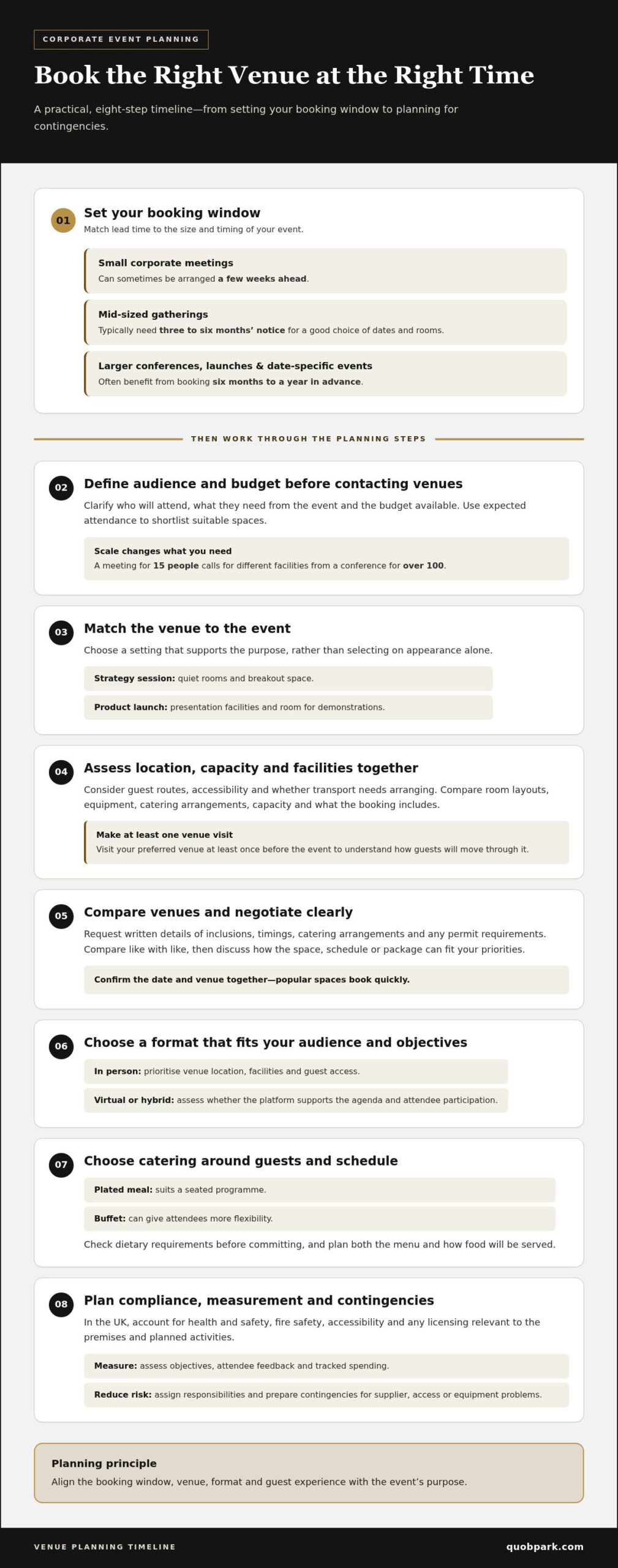
- Set your booking window. Small corporate meetings can sometimes be arranged a few weeks ahead. Larger conferences, launches and events tied to a specific date often benefit from booking six months to a year in advance. Mid-sized gatherings typically need three to six months’ notice for a good choice of dates and rooms.
- Set the audience and budget before contacting venues. Define who will attend, what they need from the event, and the budget available. A meeting for 15 people calls for different facilities from a conference for over 100. Use expected attendance to shortlist suitable spaces.
- Match the venue to the event. A strategy session may need quiet rooms and breakout space; a product launch may need presentation facilities and room for demonstrations. Choose a setting that reflects the event’s purpose, rather than selecting on appearance alone.
- Assess location, capacity and facilities together. Consider guests’ routes, accessibility and whether transport needs arranging. Compare room layouts, equipment, catering arrangements, capacity and what the booking includes. Visit your preferred venue at least once before the event to understand how guests will move through it.
- Compare venues and negotiate clearly. Request written details of inclusions, timings, catering arrangements and any permit requirements. Compare like with like, then discuss how the space, schedule or package can fit your priorities. Confirm the date and venue together, since popular spaces book quickly.
- Choose an event platform to suit the format. For an in-person gathering, prioritise the venue’s location, facilities and guest access. For a virtual or hybrid programme, assess whether the platform supports the agenda and attendee participation. Keep the chosen format aligned with your audience and objectives.
- Choose catering around guests and schedule. Plated meals suit a seated programme, while a buffet can give attendees more flexibility. Check dietary requirements before committing, and plan both the menu and how food will be served.
- Plan compliance, measurement and contingencies. In the UK, account for health and safety, fire safety, accessibility and any licensing relevant to the premises and planned activities. Measure success against objectives, attendee feedback and tracked spending. Reduce risks by assigning responsibilities and preparing contingencies for supplier, access or equipment problems.
Budget planning and cost tracking
- Set the budget ceiling and connect it to the event goal. List essential costs before choosing optional enhancements. For a conference focused on networking, protect funds for suitable space and guest refreshments. For a launch, prioritise presentation needs and marketing materials. This keeps spending tied to a clear outcome.
- Build a spreadsheet before making commitments. Create columns for category, supplier, estimate, agreed amount, payment date and actual spend. Include venue, catering, travel, speakers, entertainment, equipment and promotion. Update the sheet whenever you commit to spending, not just when an invoice arrives.
- Allow room for changes. Reserve 10-15% of the event budget for unexpected costs. Keep that amount separate from planned spending, and record any use against its reason. A guest-count change or equipment need can then be managed without losing sight of the total.
- Prioritise costs against attendee value. Separate essentials from enhancements, then rank each by its contribution to the event objective. If guest feedback shows that a previous event needed more discussion time, fund breakout space before decorative extras. Compare venue and catering options by their inclusions, not headline cost alone.
- Place the event within the marketing budget. Over half of B2B organisations spend a fifth of their annual marketing budgets on events. Use this as context, not a target: set your allocation according to your organisation’s priorities, event goals and planned activity across the year.
- Promote before and after the event. Share announcements through newsletters, your website and social media, then send countdown emails in the final weeks. Afterward, repurpose event content into useful clips or articles, and gather feedback to guide future marketing.
- Review the final figures and outcomes. Compare actual spend with estimates, then assess attendance, guest feedback and progress towards the original objective. Record what supported networking and what could be improved, so the next event budget reflects evidence rather than habit.
Coordinating speakers and entertainment
- Make the programme memorable through relevance and participation. Choose speakers and entertainment that serve the event’s purpose, then give attendees opportunities to respond, discuss and connect. A clear theme, thoughtful pacing and a shared moment can give guests something specific to remember.
- Book speakers whose expertise suits the audience. A keynote can establish the event’s tone, while a panel brings different professional perspectives together. For a product discussion, combine a knowledgeable presenter with an industry voice, then leave time for audience questions.
- Share announcements at the right point. Publish speaker announcements one to three months before the event. Use social media and invitation updates to explain each speaker’s relevance, helping potential attendees understand what they’ll gain from joining.
- Build a varied agenda around attention. Break up presentations with discussion, networking or short activities. Long, uninterrupted agendas tend to lose attention after roughly ninety minutes; schedule a change of pace before energy drops.
- Choose entertainment that encourages connection. Live music or a suitable interactive performance can break the ice and spark conversation. Match the style and volume to the setting, so entertainment complements networking rather than competing with it.
- Coordinate every speaker and performer. Share the running order, arrival instructions, speaking times and presentation requirements in advance. Name one organiser to manage introductions and transitions, keeping the programme composed if a session runs late.
- Prepare the AV details before guests arrive. Match microphones, speakers and screens to the room and presentation format. Test each microphone and presentation file on site, and brief speakers on how to advance slides and take audience questions. A simple backup copy of each presentation helps avoid delays.
- Close with a clear next step. End with a concise summary, a focused question or an invitation to continue conversations. Follow up with a thank-you and selected event highlights, giving attendees a reason to share useful moments with colleagues.
Setting event goals, dates and locations
- Write a brief using the five Ws. Define who should attend, what they should take away, where the gathering belongs, when it should happen and why it matters. For example, a meeting for prospective members may aim to build relationships, while a product-awareness event needs a different audience and programme. A clear brief is the foundation for Hosting a Corporate Event That Gets Talked About.
- Make the objective measurable. Choose an outcome you can assess, such as targeting 25% more ticket-sale revenue than the previous event by event day. For product awareness, objectives could include a 20% increase in website traffic following the event or 100 email waitlist sign-ups following it. A team-morale event could target a 10% uplift in positive company-related survey responses. Select a measure that reflects your actual purpose.
- Choose a date that supports attendance. Compare possible dates with business commitments, audience availability and the event’s purpose. A customer opportunity may suit a different point in the year from an internal planning meeting. Consider whether key participants can attend and whether the timing gives them a useful reason to take part. Record the chosen date in the brief.
- Choose a location that reinforces the goal. The venue should reflect the event’s topic and create the right atmosphere. A discussion-led session benefits from a setting that supports conversation; a product presentation needs space for guests to focus on the subject. Assess accessibility and travel arrangements alongside the impression the location creates. The setting should serve the programme, not compete with it.
- Use the brief to guide decisions. Record the audience, objective, date, location, format and success measure in one document. Share it with everyone involved in planning, so programme choices stay aligned. Before approving a change, ask whether it serves the goal. This discipline helps Hosting a Corporate Event That Gets Talked About stay focused on a meaningful guest experience, rather than attractive extras alone.
Quob Park Estate, Hotel & Spa: Quob Park Classic Cuvée
Quob Park Estate, Hotel & Spa spans 180 acres and offers a distinctive setting for considering a refined wine experience alongside a corporate gathering. Quob Park Classic Cuvée can bring English sparkling wine into a reception or shared occasion, while Quob Park Heritage Rosé Cuvée and Quob Park Blanc de Blancs offer further estate wines to consider.
If guests would value a closer connection to the vineyard, Vineyard Tour & Tasting centres the experience on the wines and their origins. The Gourmet Tasting Menu can also suit an occasion built around food and wine. These options work best when hospitality is part of the event’s purpose, not an add-on that distracts from it.
Contact the Quob Park Estate, Hotel & Spa team to discuss how its corporate event packages and wine-led experiences could complement your gathering.
Shape the Next Conversation
The strongest corporate occasions do more than fill a date in the diary. They give colleagues, clients or partners a reason to keep talking when they return to work. As you move from planning to decisions, ask what you want guests to remember and let the answer guide the details. That is the foundation for hosting a corporate event that gets talked about.
When English sparkling wine and a sense of place fit the occasion, Quob Park Estate, Hotel & Spa offers a setting to explore. Consider how its wines can complement the tone of your gathering, rather than treating hospitality as an afterthought.
CONTACT QUOB PARK ESTATE, HOTEL & SPA to discuss your event. A clear idea of your audience and the experience you want to create is a good place to begin. With purpose guiding each choice, you can shape an occasion that feels considered, welcoming and worth remembering.
Frequently Asked Questions
Need Help Sourcing a Venue?
Decide whether you need a venue or a complete event package. Quob Park offers Corporate Event Packages for venue-led gatherings. Before contacting the team, prepare a short brief covering your audience, event format and essential facilities. This helps shape a programme and setting around what the occasion needs.
How to plan a corporate event that stands out?
Give guests one distinctive reason to remember the occasion, then build the programme around it. For example, invite attendees to submit questions beforehand and use recurring themes to shape a closing discussion. A thoughtful follow-up, such as a concise record of key ideas, extends the event’s usefulness beyond the day itself. Aim for a meaningful experience, not simply an elaborate one.
What are creative corporate event themes and entertainment ideas?
Choose a theme that gives the programme a coherent character, such as craftsmanship, future thinking or the stories behind a product. Add an activity that invites participation: a live illustrator capturing ideas, a host-led industry quiz or a short demonstration linked to the theme. Keep entertainment relevant to the audience, so it adds atmosphere without interrupting conversation.
How much does it cost to host a corporate event in the UK?
There’s no single standard cost for a UK corporate event; the total depends on its format and choices. Build a pounds-based estimate that covers venue arrangements, catering, equipment, speaker or entertainment fees, travel and promotion. Attendance affects several categories, while the programme shapes technical and hospitality needs. Separate essential commitments from optional enhancements to see where adjustments will make the biggest difference.
How to choose a venue for a corporate event in the UK?
Choose a venue that works for the guest journey as well as the programme. Map how attendees will arrive, register, move between sessions and leave. Then consider how the space performs in poor weather or when the schedule changes. For a hybrid gathering, assess whether the room supports clear sound and good camera sightlines. These practical details matter as much as décor.
How to build networking and audience participation into a corporate event?
Make interaction easy to start instead of leaving every introduction to chance. Use table prompt cards linked to the event topic, invite guests to add questions to a shared board, or ask hosts to welcome people into conversations. A prompt about a current industry challenge, for example, gives attendees a natural opening. Offer quieter ways to contribute too, such as written questions.